
Rapides Projected and Actual Release
A projected date is a sentence-computation result as of a stated point in time. It is not a promise that a person will leave on that day. Louisiana DPS&C uses the official phrase “projected release date (if applicable).” Its telephone locator can provide that date for a state record when a computation exists. RPSO and the sentencing court are the better sources for a purely local Rapides Parish sentence.
An actual release record answers a later question: when did the person physically leave, under what authority, and where did the person go? Transfer to DPS&C, another jail, USMS, BOP, or ICE is not community release. A state projection also does not settle a local pretrial case or another agency's hold.
| Status | Date source | What it means |
|---|---|---|
| Pretrial parish custody | Court, bond, and RPSO records | No fixed sentence-release date may exist |
| Local parish sentence | RPSO Jail Records and sentencing court | The sheriff may control the parish computation |
| Louisiana state sentence | DPS&C sentence computation and phone locator | A projected date may be available |
| Completed release | RPSO or DPS&C release document | Shows the actual event and its status |
Find a Rapides Projected Release
Classify legal custody before searching. A person can be housed in a Rapides facility while held for Louisiana DPS&C or another agency. Ask both where the person is located and which agency owns the sentence. This distinction determines whether RPSO, the court, or DPS&C can supply a useful computation.
- Check the current Rapides custody source only to determine whether the person still appears. Absence does not prove release.
- For a Louisiana sentence, open the DPS&C imprisoned-person information page and follow its LAVNS locator route.
- Call the DPS&C telephone locator at 225-383-4580 with the DPS&C number, or the name and date of birth. Ask for the projected release date if applicable.
- For a local sentence, contact RPSO Jail Records at 318-449-5453, which is also identified for calculating parish time, and review the sentencing court record.
- Request the current sentence-computation record and its “as of” date. After the event, obtain the release or transfer record.
If DPS&C cannot provide a date, its official guidance says the calculation may be incomplete or sentencing paperwork may not yet have arrived. The time-computation information line is 225-342-0799. Do not fill that gap with a percentage calculation.
The official DPS&C locator explanation is captured below and identifies the telephone route for a projected date.
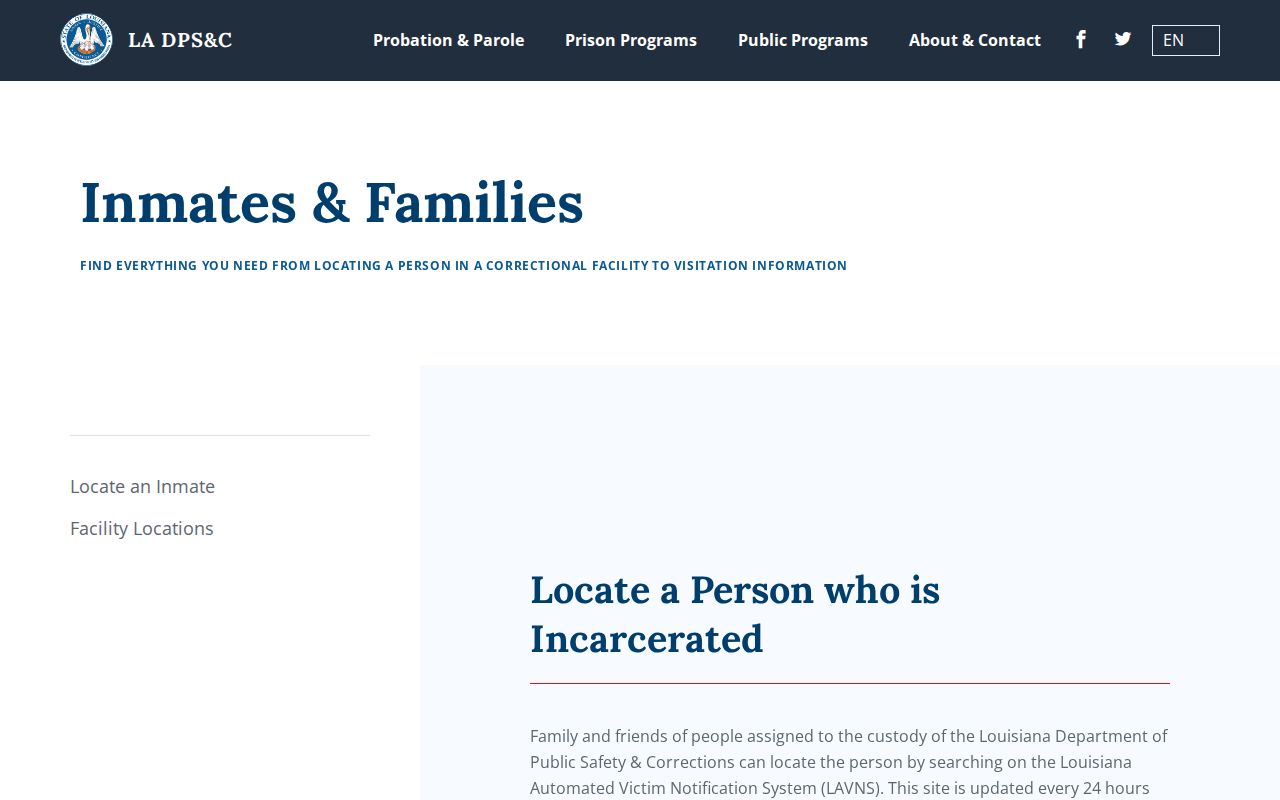
The page routes the public to LAVNS for status and to the phone locator for the projected release date. Those are related channels, but they do not return the same type of record.
Note: A LAVNS supervision result can show that prison custody ended without proving the sentence or supervision has fully discharged.
Rapides Release-Date Calculation Inputs
A sound calculation begins with the imposed sentence and the judgment. It also needs credit for time already served, the legal-custody date, whether terms run at the same time or one after another, the offense date, and the correct good-time law. Earned or forfeited credit must be current. Parole or program authority can matter as well.
“Concurrent” sentences run together. “Consecutive” sentences run one after another. A detainer is another agency's request or legal basis to hold or receive the person. Diminution is a reduction earned under a statute and applicable rules. These terms change the calculation, so they must come from official records rather than a guessed timeline.
| Input | Why it matters | Record to check |
|---|---|---|
| Imposed sentence | Sets the legal term | Judgment and sentencing minutes |
| Jail credit | Credits qualifying time already served | Judgment, computation record |
| Offense date | Selects the governing good-time framework | Charging and judgment records |
| Sentence structure | Concurrent and consecutive terms differ | Judgment and master record |
| Earned credit | May move a projected date | Current custodian computation |
| Holds or detainers | May prevent community departure | Release and transfer documentation |
Rapides Release Date Offense Divide
Louisiana has a sharp dividing line for offenses committed on or after August 1, 2024. La. R.S. 15:571.3.1 allows an eligible person convicted of a felony and sentenced to imprisonment in parish prison or DPS&C custody to earn diminution for good behavior up to 15 percent of the imposed sentence. It excludes a person convicted of a sex offense as defined in the cited law and a habitual offender sentenced under the habitual-offender statute. Presentence credit does not itself earn good time under this provision.
Full credit can yield an 85-percent service result. Still, credit must be earned and can be forfeited. The law generally places a qualifying person on unsupervised parole for the remaining full-term balance, subject to its split-sentence treatment. Thus “85 percent served” does not mean every legal consequence ends at the gate.
The post-August 1, 2024 diminution statute appears in the official-source capture below.
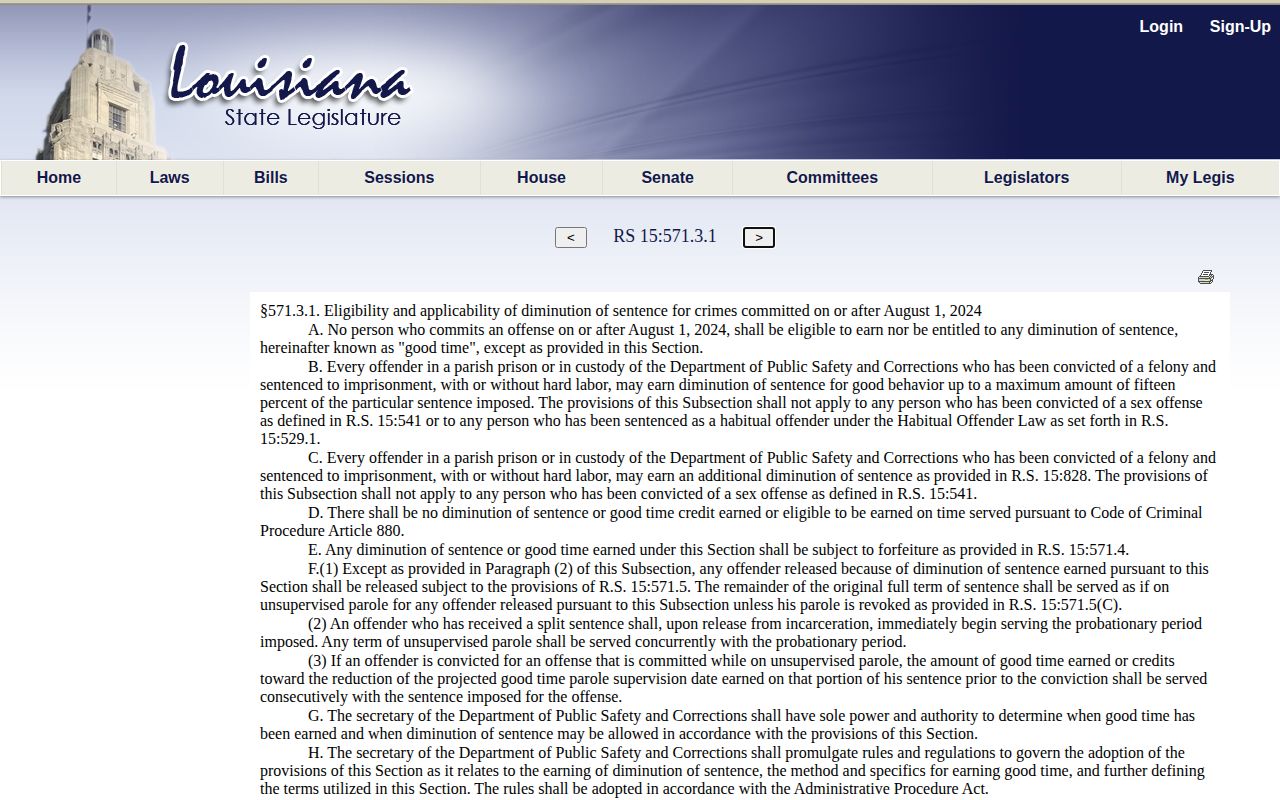
The statute image reinforces why the offense date and exclusions must be checked before applying any percentage to a Rapides sentence.
Earlier Rapides Good-Time Calculations
Earlier offenses may fall under La. R.S. 15:571.3 and the version in effect for that event. For an eligible parish prisoner sentenced without hard labor, the published older framework describes 30 days of diminution for every 30 days in actual custody. A first-time crime-of-violence prisoner uses a different rate. The sheriff has sole authority to determine when qualifying parish good time was earned under law and sheriff regulations.
Eligible DPS&C felony cases under the older framework have another published rate and exclusions. Repeat crimes of violence and specified repeat felony histories can change eligibility. The exact version, offense classification, and history must be reviewed. A modern rule should not be applied backward, and an older rate should not be carried into a later offense.
Parole eligibility is separate from diminution. For offenses on or after the same 2024 dividing date, Louisiana law generally limits parole eligibility to specified classes incorporated from other provisions. Earlier cases use the cohorts in R.S. 15:574.4, with different percentages, offense categories, histories, and exclusions. Eligibility only permits consideration by parole authority.
Note: Never calculate a person's Rapides release date from a single percentage; request the custodian's current computation and governing-law basis.
Rapides Parish-Time Release Records
A purely local sentence calls for local computation records. RPSO Jail Records lists 318-449-5453 for jail records and “Calculating Parish Time.” DOC Classification and Billing has a separate listed line at 318-449-5452. Those contacts help distinguish a parish sentence from a state offender who happens to be housed in a Rapides building. Give the person's name, booking number, facility, docket, and sentence date when known.
The Ninth Judicial District judgment supplies the imposed term, sentence structure, and court-awarded credit. RPSO applies the local custody computation within its authority. If the two sources seem inconsistent, ask whether the sheriff has received the final signed paperwork and whether the computation reflects all eligible credit. DPS&C's state phone locator should not be presented as the source for a pretrial stay or a sentence that never entered state legal custody.
Request an existing calculation rather than asking staff to predict a date from a verbal account. The useful record identifies the sentence or sentences, credited time, governing category, earned or forfeited diminution, and the calculation's effective date. A separate release or transfer record later shows whether the person entered the community, moved to DPS&C, or went to another custodian.
Why Rapides Projected Releases Change
A projected release can move even when the original sentence stays the same. The custodian may correct jail credit, receive delayed court paperwork, or apply the governing law to new facts. Earned credit can increase, while discipline or forfeiture can reduce it. A new sentence or resentencing can alter the term.
A hold may leave the projected sentence date intact while changing where the person goes. Likewise, a parole decision can affect the route without proving an immediate exit. Transfers and processing also create a gap between a computation date and a physical departure.
| Change | Possible effect | Verification source |
|---|---|---|
| Earned or forfeited credit | Moves the projection | Current sentence computation |
| Corrected jail credit | Changes credited custody time | Court and custodian records |
| New court order | Changes sentence or authority | Signed order and minutes |
| Detainer or hold | Changes destination or continued custody | Transfer and receiving-agency record |
| Parole outcome | Allows, denies, or delays a release route | Committee result plus later release record |
| Escape or violation consequence | May cause loss or forfeiture where law applies | DPS&C and adjudication records |
Confirm a Rapides Actual Release
Near the projected date, recheck legal custody and ask whether another hold exists. A person housed at Detention Center I, II, III, or the Transitional Work Program may have a local record, a DPS&C sentence, or another agency's custody. The named facility alone does not resolve that question.
Louisiana VINE can provide an event alert for a specific person, but an alert is not a certified release record. The registration process and limits are detailed on the VINELink Inmate Search page. After the event, request the release date, time, authority, type, destination, and receiving agency from RPSO or DPS&C. Compare those facts with the court record when the legal basis matters.
If the person leaves a Rapides building for state, federal, or immigration custody, record the event as a transfer. Community release, parole, diminution release, and complete discharge also differ. Exact labels preserve that distinction and prevent a projected date from being mistaken for a finished case.
For a parish booking, New World historical details can display an exact release date and time for a known booking, but the timestamp alone does not say whether the person entered the community. Ask for release authority, type, and destination. For a state sentence, request the DPS&C discharge or supervision record after the projection passes. A community-supervision result may confirm that prison custody ended while also showing that the sentence remains active in another form.
Keep the “as of” date with every computation. Sentence records can change when official court papers arrive, jail credit is corrected, credit is earned or forfeited, or another judgment takes effect. The most recent official computation should be compared with the final release document, not with an informal estimate made from the imposed term. That two-record check answers both when release was expected and what actually happened.